★★★★★✓ Verified Purchase
I gave this book to my 11-year-old son. He looked through it, read the chapters that interested him, and said, “Thanks.” He doesn’t worry about the changes in his body anymore.
Sarah J.He stopped talking. He snaps over nothing. He’s searching things at midnight. None of it means something’s wrong with him — it means puberty has started, and he needs straight answers before the internet gives him crooked ones.
One-word answers. Door closed. “Fine” to every question. You try to start the conversation and it dies before the second sentence.
Here’s what’s usually going on: he has questions, and no idea how to ask them. Most boys would rather worry for six months than say the first three words out loud. And most parents — with no script of their own — wait for a good moment that never arrives.
You asked how school was. Six ordinary words — and he went off like a firework. Then the door. Then silence.
It isn’t a personality change. His brain is being rebuilt alongside his body: the alarm system that handles anger gets more sensitive, while the part that says “don’t say that” is still years from finished. And it’s worst at home because home is where he feels safe enough to stop holding it together.
He’s the shortest in class. Or the tallest. His voice cracked first — or everyone else’s did. He compares himself in the locker room and comes away worried.
Almost every puberty worry comes down to one question: why isn’t this happening to me at the same time as everyone else? The honest answer is that there is no schedule. Two boys born a week apart can be three years apart in development — and both be completely, boringly normal.
If nobody explains puberty, he doesn’t stop wanting to know. He asks the loudest boy at school — or types it into a search bar late at night.
Neither is trying to help him. One is showing off; the other is built to keep him scrolling. He’ll see far more bodies on a screen than in real life — edited, lit, filtered — and quietly decide his own is the problem. The first explanation he hears tends to stick. It should be an accurate one.
There are things he will not bring up at dinner. Not ever. Why he suddenly smells different. Why his voice cracks mid-sentence. Why his skin broke out overnight. Whether the changes he’s noticing are normal.
+ FREE BONUS: A Mom’s Quick Guide
30-Day Money-Back Guarantee
I gave this book to my 11-year-old son. He looked through it, read the chapters that interested him, and said, “Thanks.” He doesn’t worry about the changes in his body anymore.
Sarah J.My boy started getting really moody and I could see he was worried but wouldn’t talk to me. This book made such a difference. He highlighted parts and even came to me with questions after reading it. So glad we have this.
Jess TaylorMy 10 year old had so many questions lately and I just didn’t know how to start the conversation. This book did it for me 🙏 He got the answers he needed without the awkward talks.
Rachel M.My son is 12 and this finally gave him answers. He said it explains the changes, the mood swings and even how to deal with pressure at school. He actually sat and read it in a couple of nights, which never happens 😂
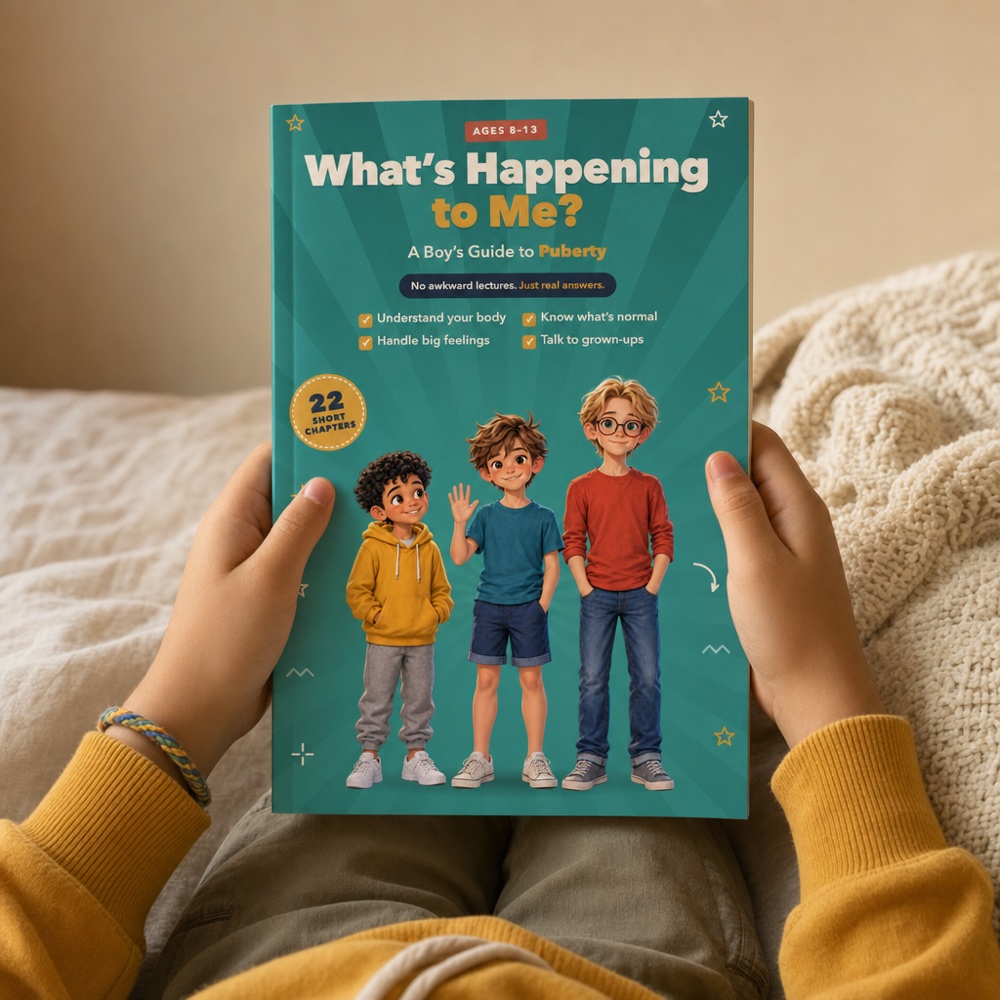
Mike R.Honestly, this should be in every home with a preteen boy. It covers body changes, hygiene, mood, school, friends and even what to do if they see something online. My son said it answered questions he didn’t feel comfortable asking anyone.
Chris L.My son is 13 and this helped him stop worrying about developing at a different pace than his friends. He said the section on confidence really hit home.
Emily R.My son had been looking things up online and getting confused. I wanted him to have accurate information and this book gave him that. He said it finally explained what’s happening in a way that makes sense.
Ben CarterLove that it shows there’s no “right” timeline and that everyone develops at their own pace. My son said it made him feel a lot better about himself.
Rebecca N.We’ve tried other books but he never read them. This one felt different — it’s made for boys and he actually wanted to read it. Worth every penny.
Matt G.Bought this after my son kept asking the same questions over and over. It explained things in a simple way and now he actually knows what’s going on with his body.
Kevin M.Covers all the topics without being weird. My son liked that it’s honest and straight to the point. He said it answered things he was too embarrassed to ask.
Jason T.Finally a book that talks about the real stuff in a normal way. My son liked that it includes tips for school, friends and even how to handle peer pressure.
Anna L.Straightforward, no embarrassing language, just clear information. Covers everything from growth and body changes to confidence and dealing with friends. Exactly what I was looking for.
Daniel K.I love that it also talks about emotions and friendships, not just physical changes. My son said it feels like it’s written for boys, not for parents.
Amanda W.Great resource for parents too. It gave me a starting point for conversations and helped me understand what he’s going through.
Megan S.Short chapters, easy to read and really practical. My son loved the real-life examples and tips. Big relief for both of us.
Laura P.My son said it’s not boring like other books and actually feels relatable. He finished it and keeps it on his nightstand.
Tom W.Really clear explanations and the tone is so supportive. My son feels more prepared and less anxious now.
Olivia H.My son said “this should be required reading at school” 😂
Stephanie C.My 11 year old read it in two days. That alone tells me it’s good.
Steven D.Wish I’d bought this sooner.
Nicole B.+ FREE BONUS: A Mom’s Quick Guide
30-Day Money-Back Guarantee